Basic Circuit Problem (2)
1) Find V1, V2 and V3 (in V) on the circuit shown below (Figure#1)
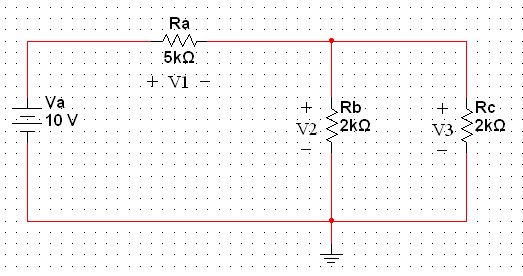
Figure#1
Circuit Analysis: Step-by-Step
Given:
Va = 10 V, Ra = 5 kΩ, Rb = 2 kΩ, Rc = 2 kΩ
Note: Rb and Rc are in parallel.
Step 1: Equivalent Resistance of Parallel Branch
Rbc = Rb || Rc = (Rb × Rc) / (Rb + Rc)
Rbc = (2 × 2) / (2 + 2) = 1 kΩ
Step 2: Total Current in the Circuit
Rtotal = Ra + Rbc = 5 + 1 = 6 kΩ
I = Va / Rtotal = 10 / 6 ≈ 1.667 mA
Step 3: Voltage across Ra (V1)
V1 = I × Ra = 1.667 × 5 ≈ 8.33 V
Step 4: Voltage across Rb and Rc (V2 and V3)
Vbc = Va - V1 = 10 - 8.33 ≈ 1.67 V
Since they are in parallel: V2 = V3 = 1.67 V
Final Results
| Parameter |
Calculated Value |
| Voltage V1 (across Ra) |
8.33 V |
| Voltage V2 (across Rb) |
1.67 V |
| Voltage V3 (across Rc) |
1.67 V |
2) Find V1, V2 (in V) and I1, I2 (in mA) on the circuit shown below (Figure#2)
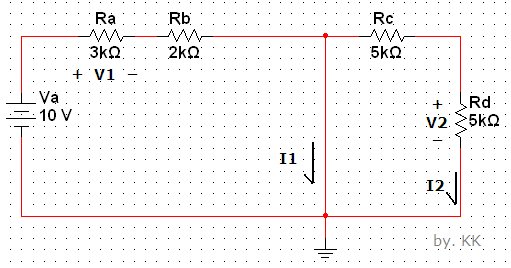
Figure#2
Circuit Solution
Note on Circuit Path: The branch with I1 is a short circuit to ground. This means all current flows through that wire, bypassing Rc and Rd entirely.
1. Total Resistance (Rtotal)
Only Ra and Rb are active in the loop:
Rtotal = Ra + Rb = 3 kΩ + 2 kΩ = 5 kΩ
2. Total Current (I1)
I1 = Va / Rtotal = 10V / 5 kΩ = 2 mA
3. Branch Current (I2)
Since the current is diverted by the short circuit: I2 = 0 mA
4. Voltages (V1 and V2)
V1 = I1 × Ra = 2mA × 3 kΩ = 6 V
V2 = I2 × Rd = 0mA × 5 kΩ = 0 V
| Variable |
Result |
| V1 | 6 V |
| V2 | 0 V |
| I1 | 2 mA |
| I2 | 0 mA |
[Back]